

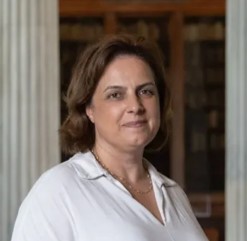
Dr. Olga Karagiorgou. Director of Reseearch, Academy of Athens
Host Institution/country: Academy of Athens, Greece
Grant: ERC Advanced Grant
Grant duration: 01.05.2026 – 30.04.2031
Grant amount: € 2 492 721
Call: ERC-2024-ADG
Domain: SH6
Acronym: Byz-GOVAG
Project in CORDIS
Byz-GOVAG
Agents of Cohesion in the Governance of an Empire: the Anthropogeography of Byzantium, 7th to 12th centuries
A small lead seal can open a remarkably detailed window onto the people who governed Byzantium. Dr. Olga Karagiorgou’s five-year ERC project will use these objects, alongside literary evidence and digital methods, to reconstruct the careers and networks of state functionaries and to turn a dispersed heritage into a platform for collaboration, access and cultural diplomacy.
Reading Byzantine lives through lead seals
Open an email and the first clues about its sender may be limited: a name, perhaps a signature, a role and an affiliation. The message itself may say more, but its visible frame can still leave much unsaid. A Byzantine letter secured with a lead seal offered a different kind of introduction. Depending on what survives and what was originally inscribed or represented, the seal may reveal a person’s identity and office, illuminate status or career progression, and sometimes offer clues to the communication’s context or intention.
That contrast raises a distinctly modern question: how much do people need – or want – to know about those who communicate with them? For Olga, the answer begins with close attention to objects that once authenticated correspondence and now preserve fragments of administrative life. Her ERC project places Byzantine state functionaries at the centre of an investigation into cohesion and fragmentation within the administration of a major, long-lasting state.
The project aims to reconstruct Byzantine administrative, political, institutional and social history through prosopography: the systematic study of people, their relationships and their careers. Literary sources form part of the evidence, but lead seals are especially important. Well over 80,000 seals survive in more than 100 public and private collections, while further examples continue to emerge from excavations. Individually, they may be modest objects. Read together, they can help trace how officials moved through posts, how authority was expressed and how the state connected people and places.
This is not simply a matter of assembling names. The project will develop career schemes for state functionaries and bring together evidence dispersed across institutions and borders. Improved photography and conservation are intended to make difficult material more legible and more secure for the future. Innovative digital and computational methods will help the researchers organise, connect and interpret a body of evidence whose scale would challenge conventional approaches.
Building an international research community
The breadth of the question demands an equally broad team. The five-year project brings together four research institutes and almost 30 senior and early-career researchers from 18 universities. Its work crosses political, military and social history, as well as epigraphy and art history. Olga prioritised the creation of a communication and conference room and hopes that virtual meetings will take place at least once every two weeks. The room represents more than infrastructure: it is a practical expression of a project designed around sustained exchange.
Collaboration also extends beyond universities. Museums are crucial partners, particularly provincial museums in Greece, Cyprus and Turkey, while private collectors hold another significant part of the surviving material. The project intends to support restoration and preservation, make objects visible through open-access databases and develop exhibitions and educational programmes for schoolchildren and people with disabilities. Research, conservation and public engagement are therefore conceived as connected responsibilities rather than separate activities.
That approach reflects the nature of the material itself. Byzantine seals are now distributed among modern nation-states, institutions and individuals, but they form part of a shared cultural heritage. Bringing them into conversation creates opportunities for international conferences and exhibitions as well as scholarship. Olga sees this extensive cooperation across countries, disciplines and scientific backgrounds as part of the project’s
intended legacy: a basis for high-quality interdisciplinary research and for cultural diplomacy.
Turning experience into a successful ERC proposal
The field has accompanied her since her doctoral studies at Oxford. A partly related ARISTEIA II project, funded in 2013-2015, strengthened her expertise and helped prepare the ground for a proposal of greater scale. She attributes the successful application to experience, dedication, hard work, love for discipline, methodical preparation, attention to detail and a network of collaborators developed over many years.
Even with those foundations, preparing the ERC proposal was among the most demanding processes she encountered. ERC funding was a deeply held ambition, and she succeeded on her first attempt. The achievement did not come from treating the application as an isolated writing exercise. It depended on aligning a large research vision with partners, methods, facilities, administration and a budget capable of sustaining the work.
Timing made that coordination especially important. Her deadline fell at the end of August 2024, when summer holidays slow parts of the Greek public sector. Olga advises applicants to begin discussions with potential institutional and individual partners at least eight months before submission, taking holidays and other slow periods into account. Nothing essential should be left until the final days.
Budget preparation was among the hardest elements. Her experience points to a need for more structured specialist support, ideally through a dedicated state bureau able to advise on employment contracts for national and international partners, taxation and related administration. The scientific case may be the proposal’s centre, but a complex international project also rests on rules and arrangements that researchers should not have to decipher alone.
The ERC National Contact Point provided targeted help at both evaluation stages. In Part A, it reviewed proposal’s drafts. In Part B, organised a mock interview that Olga found highly beneficial. The sequence matters: first sharpen the written argument, then practice explaining and defending it under interview conditions.
Creating opportunities for the next generation
Her ambitions for early-career researchers are equally concrete. She wants them to hold meaningful roles through which they can develop skills, accumulate experience, exercise creativity and build careers. In a project concerned with reconstructing professional lives from the past, that commitment gives the work a forward-looking dimension: it will not only study career trajectories but also help create them.
What Byzantine officials can teach us today
The research may ultimately bring Byzantine officials closer to present-day experience. The project will ask what their careers and communications reveal about the workings of the state, while remaining alert to continuities in institutional life. “I am absolutely convinced that the anxieties and the problems that a state functionary had in Byzantium are very similar to what a modern state functionary has to face,” Olga says.
Those parallels are questions for investigation rather than conclusions already reached. The project sets out from a vast, scattered archive and an ambitious programme of collaboration, conservation and analysis; its principal findings still lie ahead. Yet its premise is already compelling. A seal once closed a letter, protected its contents and identified the authority behind it. Centuries later, opening the evidence carried by those seals may reveal not only how Byzantium was administered, but how people working inside institutions navigated status, responsibility, connection and uncertainty.
Interview was conducted in August 2026.
Advice for future ERC applicants
- Begin discussions with prospective institutional and individual partners at least eight months before submission.
- Map the preparation period around holidays and predictable administrative slowdowns.
- Leave no essential scientific, partnership, administrative or budget tasks until the last minute.
- Treat budget development as a major workstream and seek specialist advice early.
- Build the proposal methodically, with close attention to detail and a clear division of roles among collaborators.
- Draw on a network developed over time, while ensuring that every partner has a meaningful contribution.
- If possible, contact your ERC National Contact Point for support in providing content-focused feedback on Part A.
- Use a mock interviews to practice explaining and defending the project.
- Design substantive roles for earlycareer researchers so that the project develops skills, creativity, experience and careers.