

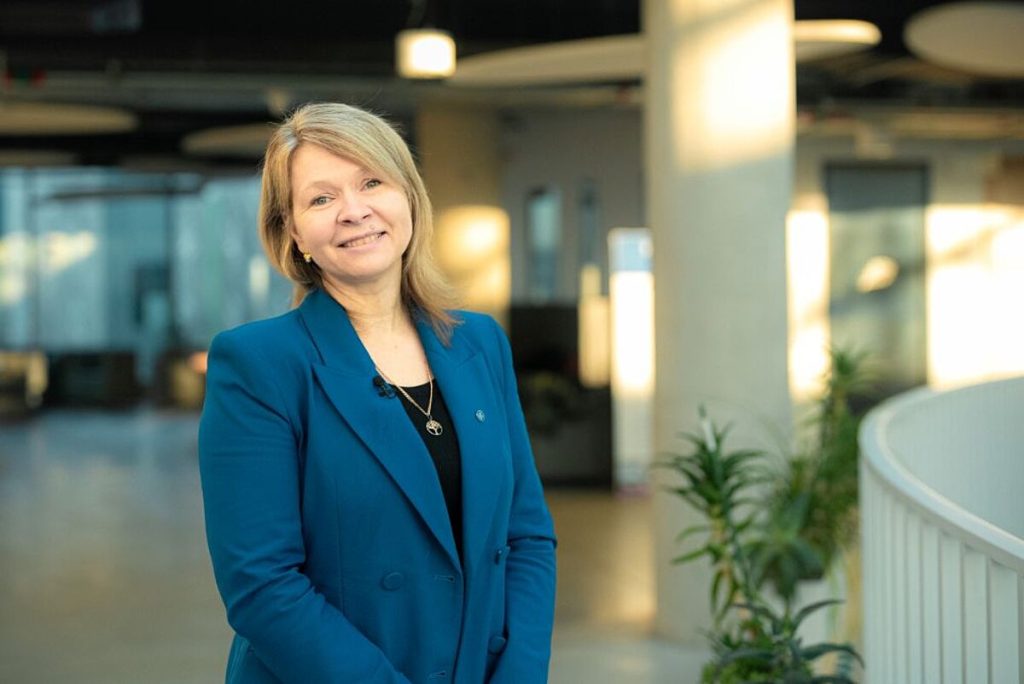
Prof. Inta Mieriņa
Host Institution/country: University of Latvia, Latvia
Grant: ERC Consolidator Grant
Grant duration: 12.05.2025 – 31.05.2030
Grant amount: € 1 996 386,25
Call: ERC-2024-COG
Domain: SH7
Acronym: WICE
Project in CORDIS
Welcoming immigrants in Central and Eastern Europe: lessons from Russia’s invasion of Ukraine
The initial welcome given to Ukrainians across Central and Eastern Europe challenged familiar accounts of the region’s attitudes towards migrants. Sociologist Inta Mieriņa’s ERC Consolidator Grant project, WICE, asks what brings groups together – and her route to funding shows the value of comparison, critical scrutiny and persistence.
Rethinking migration through solidarity
For years, Central and Eastern Europe had often been portrayed as hostile towards migrants, particularly after the 2015-2016 refugee crisis. Then, following Russia’s full-scale invasion of Ukraine in 2022, many of the same societies opened their doors widely to Ukrainians arriving in large numbers. For sociologist Inta Mieriņa, the contrast was not an anomaly to explain away. It was a sign that established ways of thinking about migrant reception might no longer capture the situations researchers were trying to understand.
There were ready explanations. Ukrainians might be seen as culturally closer to people in the region; attitudes towards people from the Middle East might be shaped by racism. Inta did not dismiss these factors. But her experience in memory politics, international relations and security politics suggested that the reasons were more complex -and scientifically more interesting.
That tension became the starting point for WICE, Welcoming immigrants in Central and Eastern Europe: lessons from Russia’s invasion of Ukraine, funded through an ERC Consolidator Grant. Rather than beginning with hostility, the project reverses the usual direction of inquiry. “A major focus is understanding what brings people together, rather than only what divides them.” In today’s divided world, it is difficult to overstate the importance of this question.
Migration research has often examined prejudice, racism, xenophobia and divisions between groups. WICE instead asks what makes people perceive another group as part of us rather than them, and what makes them willing to help others, sometimes at a cost to themselves. The ambition lies in using an unexpected historical moment to reassess familiar assumptions and build a more precise account of solidarity.
Connecting rigorous research with public debate
The question may sound intuitive, but answering it requires a demanding research programme. Comparative fieldwork is planned in Latvia, Poland, Hungary and Italy. Inta describes the need to organise quantitative fieldwork and international tenders, build a team and then undertake analysis robust enough to withstand critical scrutiny. Research ethics create further responsibilities. These are presented as planned elements of the project, not completed results.
The pace of academic work once felt unusual to Inta, who began her career in market research. Moving into academia, she was surprised that a study could take one or two years. She came to see why social science needs that time: its task is not to confirm an answer that seems obvious, but to examine complex behaviour carefully and objectively.
This view also shapes her understanding of impact. Social scientists are under pressure to produce directly applicable solutions to everyday problems. Inta acknowledges our mission as scientists to take an active role in the betterment of our societies, however, she resists making immediate utility the fundamental test of research. Scientists, she argues, should seek to understand the world, in a reflexive and open-minded way, rather than adopt or further a any political position such as whether migration is good or bad.
Even so, WICE is intended to connect evidence with public discussion. One planned output is a set of communication guidelines facilitating a sense of togetherness rather than sowing further division. In line with the principles of dialogic socilogy, Inta also wants NGOs, policymakers, teachers, educators, journalists and other stakeholders involved throughout the project. Their participation can help keep the research grounded and make them more likely to engage with its eventual recommendations.
Inta identifies a contradiction: governments may recognise a future need for workers and develop targeted policies to attract labour in particular sectors, while attitudes towards refugees from some regions remain restrictive. Politicians may hesitate to discuss migration openly because it is controversial. Research cannot settle that debate by telling people what to think, but it can reveal more nuance than polarised positions allow.
At either ideological end, she sees small minorities: people who would close borders completely and people who would accept everyone regardless of circumstances. Between them is a much larger group willing to discuss policies that are both humane and realistic. Better evidence could create the conditions for a more honest conversation.
Why international comparison matters
Inta’s comparative outlook was shaped by international mobility. At Yale, as Fulbright scholar and 2016 Juris Padegs fellowship reciepient, she met scholars whose work she had previously only read and encountered – top academics in her field, UN representatives, renowned journalists and other leading professionals. The experience brought her close to a major centre of scientific exchange, while also revealing its limits. Researchers there naturally followed the most topical global questions, but interest in her region could be limited unless it connected directly to Russia or Ukraine.
That realisation strengthened her belief that European researchers must study their own region through its historical, social and political experiences, then bring those insights into global knowledge. Mobility also encouraged her to look for parallels across countries and historical periods and to think more ambitiously about methods. Comparison provides a reference point: without it, a researcher may struggle to judge what is typical, exceptional, large or small.
International networks were equally important to her proposal journey. During her doctoral studies, few researchers in Latvia were working on the questions that interested her. She attended as many conferences, seminars, workshops and summer schools abroad as she could. Those encounters supported her intellectual growth and later gave her access to the range of perspectives needed to test an ERC proposal.
Learning from rejection and strengthening the proposal
Her three previous ERC application had not succeeded. In one attempt, the mock panel she built consisted mainly of people from her immediate surroundings; they missed issues that the actual panel later noticed. For the successful application, she examined the profiles of experts involved in panels in previous year – their topics, countries and disciplines -and assembled a mock panel with a comparable breadth of competence. She also shared the proposal with readers from different countries and disciplines. They saw vulnerabilities that she and her immediate team might never have identified, and allowed to rectify them.
Preparation for the interview was intensive. Inta practised until she could give the presentation almost from memory. She anticipated possible questions and prepared short, pointed answers. None of the questions in the successful interview surprised her. That readiness was not about yielding to every alternative proposed. It was about knowing the project well enough to acknowledge other possible methods, or perspectives, and explain clearly why her chosen approach was justified.
The process taught her to value fair criticism over reassurance and clarity over accumulation. Friendly approval does not prepare an applicant for a panel. Nor does squeezing every possible element into a proposal. The stronger application was streamlined around one clear idea, concept, theory or innovation.
Building confidence through persistence
Underlying those lessons is a question of confidence. Researchers in Latvia, and perhaps the region more broadly, can be too modest about their work, Inta believes. ERC ambition requires recognising the strength of an idea and daring to make the case for it. It also requires resilience: “You may not be successful the first time. But you will learn. You will fall, you will stand up again, and you can apply again. Persistence pays off – in my case, it took four attempts to finally succeed.”
Interview was conducted in August 2026.
Advice for future ERC applicants
- Build the proposal around one clear, ambitious idea, concept, theory or innovation.
- Keep the application streamlined, do not try to include too much.
- Seek feedback of reviewers from different countries and disciplines, not only close colleagues.
- Ask for rigorous criticism from people willing to expose weaknesses before the panel does.
- Study the range of expertise represented on earlier panels and reproduce that breadth in a mock panel.
- Practise the presentation repeatedly and prepare short, direct answers to likely questions.
- Know the project well enough to acknowledge alternatives while defending your choices.
- Use conferences, seminars, workshops and summer schools to build international networks and comparative insight.
- Do not wait for a perfect publication record if the central idea is strong.
- Learn from an unsuccessful attempt and be prepared to apply again.