

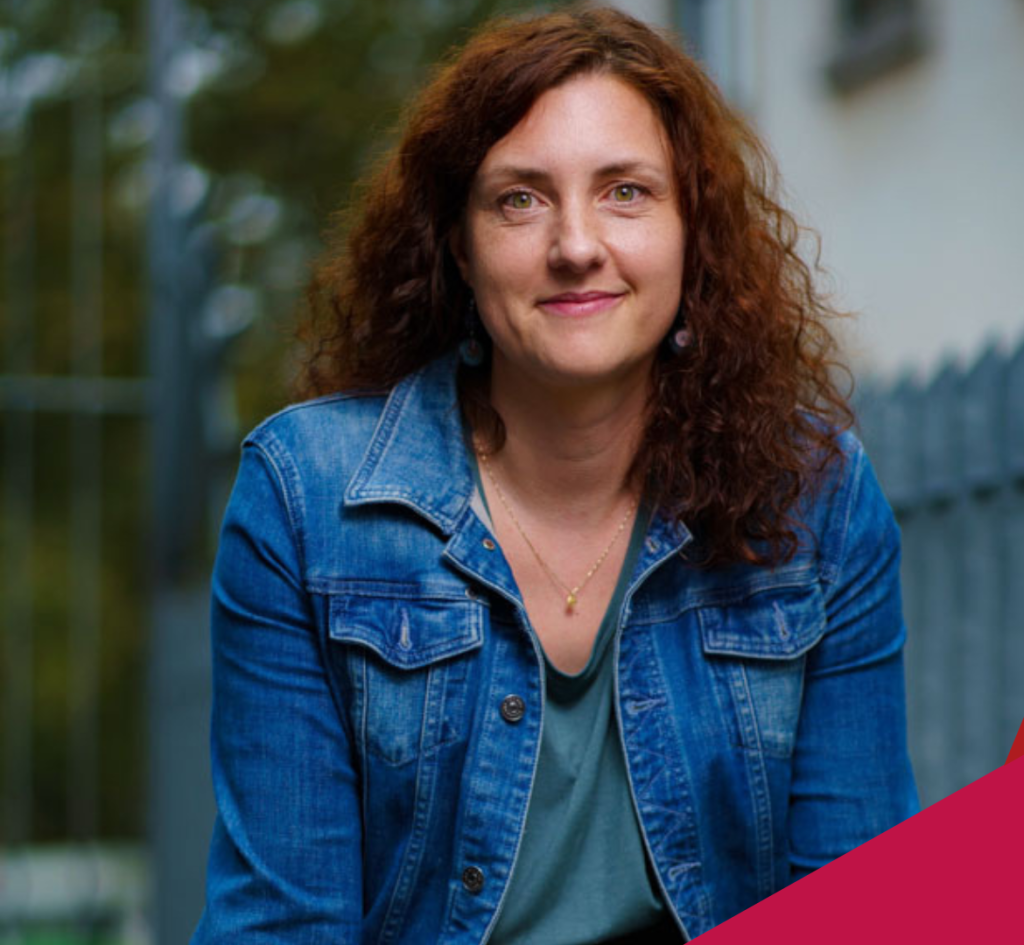
Assoc. Prof. Mojca Plesničar
Host Institution/country:
Institute of Criminology at the Faculty of Law, University of Ljubljana, Slovenia
Grant: ERC Starting Grant
Grant duration: 01.01.2025 – 31.12.2029
Grant amount: € 1 598 495
Call: ERC-2024-STG
Domain: SH3
Acronym: Sentrix
Project in CORDIS
The Sentrix project introduces a new approach based on decision architecture to investigate a complex social and legal question: How do judges make sentencing decisions?
Criminologist Mojca Plesničar is examining how judges’ decisions are shaped not only by law and case facts, but also by the systems and professional environments around them. Her route to an ERC Starting Grant began with rejection, then a decision to enlarge the question rather than retreat from it.
Looking beyond individual decisions
Why can apparently similar cases lead to different sentences? Mojca Plesničar, Senior Researcher at the Institute of Criminology and Associate Professor at the Faculty of Law, University of Ljubljana, has spent much of her career studying sentencing decisions as part of a broader interest in how people make choices. With her ERC Starting Grant project, Sentrix, she is moving beyond a list of individual influences to investigate what she calls the sentencing architecture or sentencing environment.
The project starts from a familiar premise in behavioural economics: decisions are embedded in their surroundings. Mojca illustrates it with a shop, where products at eye level attract attention more readily than those placed higher or lower. Legal decisions also take place within an environment that makes some options feel more natural or straightforward than others.
For sentencing, this means looking beyond the conventional picture of a judge applying the law to the facts and arriving at a direct answer. Judges bring prior knowledge, ideas and cognitive patterns to the task. The system brings its own established routes, practices and expectations. It is the interaction between the individual and that infrastructure that produces the eventual decision – sometimes in ways that conflict with what the public regards as common sense.
Mojca sees this as an important role for research: questioning what appears self-evident and showing where reality is more complex. Criminology, in her view, repeatedly demonstrates the limits of simple assumptions – for example, that a severe punishment will necessarily deter offending or that a particular intervention must produce a predictable consequence. Sentencing provides a way to disentangle the legal, personal and institutional elements that common sense tends to collapse into one.
Building an ambitious, multidisciplinary project
Sentrix therefore uses a broad methodological platform: statistical data, interviews, courtroom observations, experiments and simulations. These are not parallel activities added for scale. Each method reveals an aspect that another cannot capture, while their combination allows the same problem to be examined from several perspectives. “The fact that an ERC project allows you the time and resources to use mixed methods is one of its greatest strengths,” Mojca says. For social scientists often restricted to smaller questions by time and funding, that breadth changes what can be asked.
The project begins with Slovenia, the system she knows best and can interpret most closely. But Slovenia is a starting point rather than the project’s limit. Mojca is also looking at other systems through interviews and courtroom observations. Her ambition is to identify elements that move sentencing systems towards greater or lesser punitiveness and to establish a framework that can illuminate sentencing across different settings.
That scale marks the decisive change from her first ERC application. The earlier proposal was a classical comparative study of sentencing in four European countries representing different approaches. She still regards it as a satisfying proposal, but not ambitious enough for the ERC. In the successful application, she dared to claim more: that the research could uncover principles of sentencing across systems rather than simply compare a small number of countries.
Learning from rejection and reshaping the proposal
Reaching that point required recovering from rejection. Mojca was devastated when the first application failed and briefly wondered whether she was capable of research at that level.
Time altered the judgement. The reviewers’ comments were not wholly negative, they also
identified aspects they valued. That made the feedback usable. The failed bid could become material for a stronger proposal rather than a final verdict on the researcher.
Her writing changed alongside the scope. In Part B1, she learned not to overload the central idea with detail that belongs in Part B2’s implementation framework. She also wrote for a panel whose members would not necessarily specialise in her precise topic. That meant giving more context than a disciplinary audience might need and explaining why the question mattered beyond her own field.
For Mojca, this is a form of storytelling. The research question sits at the centre; the proposal builds around it to show why the story matters. The approach does not simplify the science. It gives a diverse panel a coherent route into an ambitious project.
Finding support and preparing for the interview
Several kinds of support helped her find that route. Colleagues shared both successful and unsuccessful applications, allowing her to see their structures and, reassuringly, how different strong proposals could look. Slovenia’s ERC National Contact Point also organised reading sessions using applications whose authors had agreed to share them.
A visit to an ERC grantee offered another perspective. The researcher advised Mojca on applying and managing a project, but the visit also made an ERC grant feel less remote: a very large research project, certainly, but not fundamentally unlike projects she had managed before. Just as importantly, time away from her institution gave her space to think about what she truly wanted to investigate. She then put that idea into conversation with others, exposing it to criticism and deciding which suggestions to adopt.
Three mock interviews tested the result in different ways. European sentencing specialists helped her sharpen and defend the idea within the field, even though their questions were too detailed to resemble a panel’s. Institute colleagues then conducted the deliberately severe session she had requested, probing methods, content and implementation for about two hours. She left exhausted but reassured that she could withstand difficult questioning and use unanswered questions to prepare. A final mock interview, organised by the National Contact Point with former panel members and grantees from her broader field, more closely simulated the evaluation setting.
From research findings to practical impact
Sentrix is currently focused on understanding what happens in sentencing, not on building a tool that recommends sentences to judges. Mojca sees the eventual findings as potentially valuable to legislators and designers of sentencing systems. They may also help judges recognise influences beyond guilt, previous convictions and the facts of a case— such as the normal sentence in a court, professional culture or a prosecutor’s recommendation. Greater awareness could support more conscious decisions, while any practical application remains a later possibility rather than the project’s present objective.
For researchers considering the same path, Mojca returns to confidence. She observes that applying can feel natural in some research environments and exceptional in others. Where ERC applications are less common, taking the step demands more courage. Her own experience makes the case without disguising the risk: rejection can hurt, criticism can be severe and the second proposal may need to become bolder. “But it is absolutely worth trying!”
Interview was conducted in August 2026.
Advice for future ERC applicants
- If an earlier proposal fails, separate useful reviewer feedback from the final outcome and use it to revise the idea.
- Test whether the question is ambitious enough for ERC level and do not stop at a conventional comparison if a broader scientific principle can credibly be investigated.
- Keep Part B1 focused on the central idea and its significance, reserve detailed implementation for Part B2.
- Write for panel members beyond your precise speciality and explain why the question matters to science more broadly.
- Read varied successful and unsuccessful applications to understand structure without assuming there is a single model.
- Put the idea into conversation with other people and decide deliberately which criticism to incorporate.
- Use several mock interviews with different audiences: field specialists, demanding colleagues and panel-like reviewers.
- Treat unanswered mock-interview questions as preparation material, not as evidence that you should withdraw.