

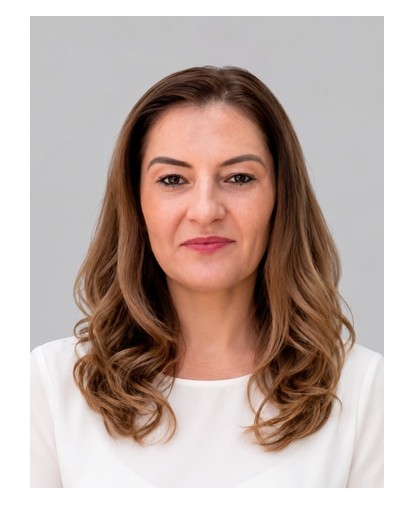
Prof. Alida Timar
Host Institution/country:
Babeș-Bolyai University, Romania
Member of Academia Europaea
Corresponding member of Romanian Academy
Grant:
- ERC Starting Grant
- ERC Consolidator Grant
Grant duration:
- 01.04.2016 – 31.03.2022
- 01.01.2023 – 31.12.2027
Grant amount:
- € 1 500 000
- € 2 657 000
Calls:
- ERC-2015-STG
- ERC-2021-COG
Domain: PE10
Acronyms/projects in CORDIS:
At Babeș-Bolyai University in Romania, prof. Alida Timar studies how quartz can preserve information about time. Her two ERC proposals grew from results that first looked like problems – and from the conviction that ambitious science matters more than discouraging statistics.
Finding scientific potential in unexpected results
Quartz is easy to overlook precisely because it is so common. It is present in beach sand, rocks and dust, and even travels on the soles of our feet. For prof. Alida Timar, Professor at Babeș-Bolyai University, that ubiquity is not a limitation but the mineral’s scientific power. Using luminescence and electron spin resonance dating techniques, she investigates the information held in quartz and what it can reveal about time.
The questions that led to her ERC-funded research did not begin with tidy confirmation. During her PhD, Alida found that something was not right with the dating method she was using. She contacted leading experts, built connections and persisted until others began to take the finding seriously. Then came a deceptively simple suggestion: “Why don’t you apply for an ERC grant?”
She did – and her 2015 Starting Grant proposal, INTERTRAP, succeeded on its first submission. The experience established a pattern that would shape her next proposal: rather than dismiss an unexpected result, she would examine what new scientific direction it might open.
That second opportunity emerged during the Starting Grant, when she encountered problems with another dating method. At first, she tried to work out how to fix them. No solution came. Gradually, the question changed. Instead of treating the problem only as an obstacle, she began to ask whether it could be useful for something else. That reframing became the seed of PROGRESS, her 2021 Consolidator Grant.
Building a high-risk idea into a strong proposal
The new idea carried scientific risk. It represented a slight change of field and could not be presented as a simple continuation of the Starting Grant.
Alida spent about two years developing it. The core concept remained largely stable, but she read extensively, familiarised herself with other methods and worked to show that the proposal combined genuine ambition with a credible route to delivery. Because this was a bid for consecutive ERC funding, she felt an additional responsibility to be exceptionally well prepared.
Preliminary work was central to that balance. Alida is clear that an applicant should not complete the whole project before seeking support; doing so would defeat the purpose of the grant. But evidence that the underlying approach can produce meaningful results helps make a high-risk idea believable. In her application, preliminary findings served two purposes: they located the proposed work against the state of the art and showed how the research could move beyond it.
For her, an ERC-level project is not a bundle of techniques assembled around a topic. It needs a clear, new idea with intellectual unity—one that reflects the applicant’s highest scientific ambition. That standard shaped not only the proposal but also her preparation for evaluation.
Preparing for evaluation and managing uncertainty
Alida prepared seriously for both interviews. For the Starting Grant, she held mock interviews and discussed the project with leading specialists in her field. For the Consolidator Grant, she widened the circle to include researchers from very different disciplines. Whenever a possible question occurred to her, she wrote it down; the list eventually ran to hundreds. The aim was not to predict every exchange, but to practice handling difficult questions and build confidence under pressure.
The Consolidator Grant process also brought a prolonged period of uncertainty. Her proposal was placed on the waiting list, one or two positions below the funding line. She describes the experience as excruciating.
Looking back, she believes one interview answer may have worked against her—not because she lacked a response, but because she mismanaged the remaining time. After giving a long answer to an unexpected and demanding question, she realised that only two minutes remained and rushed the next response. The lesson was practical: a strong answer must be both clear and appropriately brief.
Her psychological approach was equally deliberate. “I never approached it psychologically as, ‘I have a 30% chance.’ I thought – I am going to the interview, and I will get the grant!” That confidence did not replace preparation; it rested on it.
Challenging statistics and finding support
The support environment around Romanian applicants changed between her two grants. When Alida prepared her Starting Grant proposal, she says the dedicated structures now available in Romania did not really exist. She now points to a dedicated National Contact Point and a specialised office at her university that supports ERC applicants and grantees. She welcomes that development, while her own route also shows the value of seeking criticism and expertise beyond formal institutional channels.
Statistics can create a different kind of barrier. Early in her Starting Grant, a researcher told her that applying was irrational given the success rate in Eastern Europe at the time. Alida’s response is to shift attention from aggregate numbers to the individual proposal. Applicants should examine their track record and idea, discuss the project with others and compare their scientific profile and achievements with those of researchers who have secured ERC funding. A track record matters, she says, but the idea matters even more.
She also rejects the assumption that researchers from Widening countries do not belong in the competition. In her account, nationality and the host institution should not determine the scientific assessment; researchers should concentrate on the science rather than disqualify themselves in advance. “If you believe that you have a genuinely strong idea and the scientific profile to pursue it, don’t disqualify yourself before you even apply.”
Turning unexpected findings into a lasting impact
Across a decade of ERC funding, Alida says the support changed her career. It allowed her to develop ideas born from unexpected findings, create research infrastructure, combine techniques and establish a team. The larger significance of her journey lies in that transformation: a negative result need not be the end of an investigation. With time, evidence and ambition, it can become the question that defines the next one.
Interview was conducted in August 2026.
Advice for future ERC applicants
- Start with a clear, genuinely new scientific idea – not a collection of loosely connected techniques.
- Use preliminary results to establish feasibility, define the state of the art and show how the project will move beyond it.
- Do enough preparatory work to make an ambitious proposal credible, but do not carry out the entire project before applying.
- Discuss the idea with leading specialists and researchers outside your field.
- Prepare a wide bank of possible interview questions and practise answering under time pressure.
- In the interview, balance substance with brevity; protect enough time for the questions that follow.
- Assess your own idea and track record rather than letting country-level success statistics decide for you.