

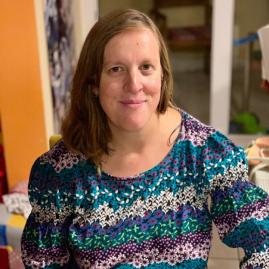
Prof. Jadranka Šepić
Host Institution/country: University of Split, Croatia
Grant:
- ERC Consolidator Grant
- ERC Proof of Concept
Grant duration:
- 01.09.2020 – 28.02.2026
- 01.04.2025 – 30.09.2026
Grant amount:
- € 806 250 2. € 150 000
Calls:
- ERC-2019-STG 2.
- ERC-2024-POC
Domain: PE10
Acronyms/projects in CORDIS:
Estimating contribution of subhourly sea level oscillations to overall sea level extremes in changing climate
Oceanographer Jadranka Šepić studies meteotsunamis: locally destructive, tsunami-like waves driven by rapid atmospheric changes. Her ERC journey links years of foundational research with a push for scientific independence, real-time detection and the persistence to apply before conditions feel perfect.
Understanding Meteotsunamis
To somebody standing on the shore, a meteotsunami can look like a tsunami caused by an earthquake. Water may rise by a metre within minutes, or retreat so abruptly that a harbour appears almost empty. The effects are usually concentrated in one bay, harbour or a somewhat larger stretch of coast rather than across a vast region, but they can still be destructive. Jadranka notes that the difference between the lowest and highest sea level can reach six metres or more, and that a six-metre event has been observed in Croatia.
The cause begins in the atmosphere. Rapid changes in air pressure over a relatively small area, sometimes associated with summer thunderstorm clouds, create a response in the sea. Under particular conditions, the atmospheric disturbance moves at the same speed as the waves below it. Resonance then allows a small wave to grow: Jadranka gives the example of an offshore wave increasing from five centimetres to 50 centimetres. As it enters shallow water, it slows, shortens and rises, potentially reaching six metres or more near the coast.
From Sea-Level Records to a Research Project
Understanding how often such oscillations occur required a change in available evidence. Sea level was traditionally recorded once an hour because mechanical instruments made more frequent measurements difficult. By the end of the 20th century, technology allowed observations at intervals of a minute or less. After the Sumatra tsunami in December 2004, the scientific community recognised the value of one-minute measurements for seismic-tsunami warning systems. Many countries began collecting such data and making them publicly available.
Jadranka, an oceanographer at the University of Split, had already been studying Mediterranean meteotsunamis when she recognised another use for those records. Tsunami-like oscillations appeared in datasets from around the world at periods of few to few tens of minutes. With 10 to 15 years of oneminute observations available, she saw enough material to begin constructing a basic climatology. That insight became central to SHExtreme, her ERC Starting Grant project, which focused on estimating the contribution of sub-hourly sea-level oscillations to overall extremes in a changing climate.
The proposal was ambitious, but it did not represent a sudden change of field. It built on Jadranka’s PhD research into meteotsunamis and her subsequent study of global datasets and their climatology. She already had initial results and two published papers that introduced the project’s topic. She believes the work would have continued without ERC support, but more slowly and with fewer collaborators. A major benefit of the grant was the ability to employ additional young researchers.
The Pursuit of Scientific Independence
The funding also offered something less easily quantified: scientific independence. Jadranka describes a positive relationship with her supervisor and says she could contribute ideas and steer work that she led. Even so, she wanted the space to define a programme as her own. “I wanted time to think about my ideas, develop them and lead the research from beginning to end.”
Overcoming Doubt and Finding the Will to Apply
Reaching that point required overcoming delay and self-doubt. Jadranka uses the Croatian idea of dišpet to describe a positive form of defiance: the determination to act when somebody suggests that something cannot be done. Like many researchers she knew in Croatia, she had repeatedly intended to apply, only to consider postponing when the call arrived and the writing had to begin.
Beneath the pressure of time, she says, can lie a fear that the application has little chance of success.
In 2018, after returning from holiday, she told her husband she would wait another year because there was not enough time. His response was blunt: “No, you will have even less time next year. You have to apply this year.” She followed the advice and produced the proposal in roughly six to eight weeks. The scientific idea was already developed, and an unsuccessful application for an MSCA Postdoctoral Fellowship had yielded useful reviews.
The practical challenge was working out what an ERC proposal should look like. Jadranka could not find a successful example in her field, and although Croatia already had some ERC grantees, their research areas were different. Videos and instructions helped only so far. The structure beyond the prescribed elements, and the budget, both had to be worked out. Eventually, she concluded that the absence of a model gave her freedom to organise the case as she thought best. The essential task was to do the work and write.
The Importance of Support and Institutional Backing
Support has since improved. Jadranka says Croatia now has more ERC grantees and a helpful National Contact Point. Prospective applicants also approach her for general advice, critical reading and, in many cases, access to her application. She sees value in support from several directions: National Contact Points and grantees can explain how to present the excellence of the project, the applicant’s CV, the idea and its feasibility. National and institutional backing matter too, especially protected time to write, which signals that the institution regards an ERC application as worthwhile.
Challenges After Winning the Grant
Winning the grant did not remove uncertainty. Scientifically, some lines of research took longer than planned. Administratively, Jadranka was among Croatia’s first ERC grantees and essentially the first at her university, so processes were unfamiliar and she had to work with the project officer to establish what was required. She notes that, in some Eastern European research systems, much of this work can fall on the principal investigator unless a dedicated person is employed. Recruitment brought another constraint: she found PhD students relatively easy to recruit in Croatia, but postdoctoral researchers much harder.
Towards Real-Time Detection
The research is now moving from understanding towards real-time detection through MeD-Track, an ERC Proof of Concept project. Forecasting remains difficult. Atmospheric and ocean models, combined with probability-based methods, may indicate that an event could occur, but estimating its final wave height is much harder. Thunderstorm clouds associated with meteotsunamis are not always predicted accurately enough in place and time. As Jadranka puts it, “The sea is the easier part. The difficult part is the atmosphere.”
MeD-Track is therefore exploring two ongoing approaches to observing atmospheric conditions directly: stations that track air pressure and meteorological-radar reflectivity data. Jadranka says both are showing promising results, but she is clear about the limitation. Even an effective early-warning system would probably provide only around 30 minutes to one hour of notice. The work has not yet delivered such a system, it is testing the real-time information that one would require.
Interview was conducted in August 2026.
Advice for future ERC applicants
- Apply early enough to preserve another opportunity if the first review is unfavourable.
- Do not wait for perfect circumstances; a well-developed idea can be turned into a proposal under a firm deadline.
- Use reviews from unsuccessful applications to strengthen the next proposal.
- Build on established expertise and evidence while showing how the ERC would expand the team, pace or independence of the work.
- If examples are scarce, choose the structure that makes the scientific case clearest and then write it.
- Think like a reviewer: make the project’s excellence, the CV, the idea and its feasibility easy to identify.
- Ask trusted, critical readers to review the application and receive their comments without defensiveness.
- Seek help from National Contact Points and ERC grantees, and ask the institution for protected writing time.